Electronics Engineering · CHAPTER 01 · FOCUSED LESSON

Cathode-Ray Television

Rosing and Campbell-Swinton move television toward electronic display.

1907 onwardALI'S NOTES · PAGE 15

The cathode-ray tube replaced the receiving disk with a beam.

Boris Rosing and A. A. Campbell-Swinton moved television toward electronic display by steering an electron beam across a phosphor screen.

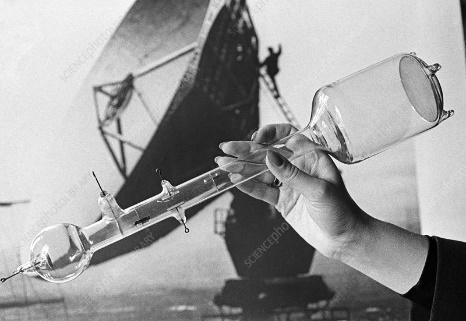
Early cathode-ray television experiment
An early CRT receiver experiment from Ali's course document.Selected from Ali Chourba's original course document.
01
TWO DEVELOPMENT PATHS

Mechanical scanning versus electronic scanning.

After 1900 inventors pursued two major approaches. Mechanical systems used Nipkow-style rotating disks at the camera, display or both. Electronic systems used vacuum tubes to generate, steer and detect electron beams.

Lee de Forest's 1906 Audion was essential because weak image signals required amplification before they could control a display reliably.

02
ROSING'S HYBRID

Mechanical camera, electronic receiver.

In 1907 Russian engineer Boris Rosing transmitted simple black-and-white silhouettes using a mechanical mirror drum at the camera and a cathode-ray tube at the receiver. He showed that a signal created by a mechanical scanner could be transformed into a visible pattern electronically.

Campbell-Swinton independently proposed cathode-ray methods and later described electronic scanning at both transmission and reception. Their work established the architecture even before every tube was practical.

03
HOW A CRT DRAWS

Generate, steer, modulate, glow.

An electron gun emits and accelerates a narrow beam in an evacuated tube. Electric or magnetic fields deflect the beam horizontally and vertically. The image signal controls beam current, and a phosphor coating emits light where the beam strikes.

A synchronized raster repeatedly sweeps the beam across the screen line by line. Because the phosphor response and human vision persist briefly, the separate samples appear as one complete moving image.

CONTROLLED MODEL

Follow the beam through one raster frame.

The visible spot traverses successive lines; it no longer jumps randomly around the screen.

CAUSE → EFFECT
ELECTRON
GUN
DEFLECTION
PHOSPHOR

Beam held at the first sample

THE IDEA TO REMEMBER

A CRT picture requires four coordinated actions: electron emission, beam focusing, synchronized deflection and brightness modulation.

01

SOURCE

Electron gun
02

POSITION

Deflection fields
03

LIGHT

Phosphor screen

COURSE SOURCE · “ELECTRONICS AND TECHNOLOGY” · ALI CHOURBA