Electronics Engineering · CHAPTER 01 · FOCUSED LESSON

Conductors & Insulators

Why some materials carry charge easily while others protect us from it.

Circuit languageALI'S NOTES · PAGE 10

Materials define where charge can move.

A useful circuit requires both easy paths and blocked paths. Conductors carry current; insulators separate those conductors and protect the user.

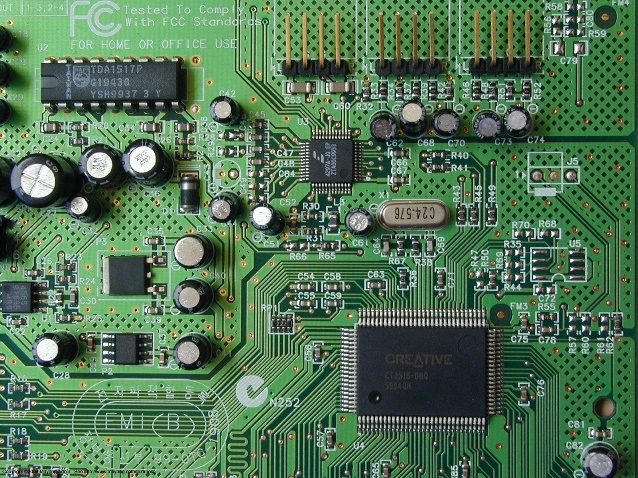
Close-up of a printed circuit board
Copper tracks are separated by insulating substrate and coatings.Selected from Ali Chourba's original course document.
01
CONDUCTORS

Mobile charge carriers make a low-resistance path.

Copper, iron and steel are electrical conductors. Metals are used in plug pins, contacts, wires and circuit-board tracks because their electrons can respond to an applied electric field and carry current. In an incandescent lamp, a metal filament conducts while its resistance converts electrical energy into heat and visible light.

Conductivity is a material property, but component resistance also depends on length and cross-sectional area. A long thin wire can have much more resistance than a short thick wire made from the same metal.

02
INSULATORS

Restricted charge motion keeps paths separate.

Plastic, rubber, glass and dry wood are common insulators. A cable's metal core provides the desired conductive path while the polymer jacket prevents contact, limits leakage and reduces shock risk. Circuit boards use an insulating base so neighbouring copper traces can carry different voltages.

Insulator does not mean impossible to conduct under every condition. Excessive electric field can cause dielectric breakdown; moisture and contamination can create surface leakage. Safe design respects voltage rating, thickness, temperature and environment.

03
DESIGN PRINCIPLE

Every circuit is built from permission and isolation.

The engineer decides where charge is permitted to move, then blocks unwanted routes. A good layout therefore requires conductors, insulators, controlled spacing and protective enclosures—not merely a collection of components.

THE IDEA TO REMEMBER

Conductors create intended current paths; insulators create electrical boundaries and safety margins.

01

CONDUCTORS

Copper, iron, steel
02

INSULATORS

Plastic, rubber, glass
03

LIMIT

High fields can cause breakdown

COURSE SOURCE · “ELECTRONICS AND TECHNOLOGY” · ALI CHOURBA