Electronics Engineering · CHAPTER 01 · FOCUSED LESSON

Farnsworth’s Image Dissector

Photoemission and scanning transform a focused optical image into a signal.

1927 · United StatesALI'S NOTES · PAGE 15

Farnsworth scanned an electron image without a disk.

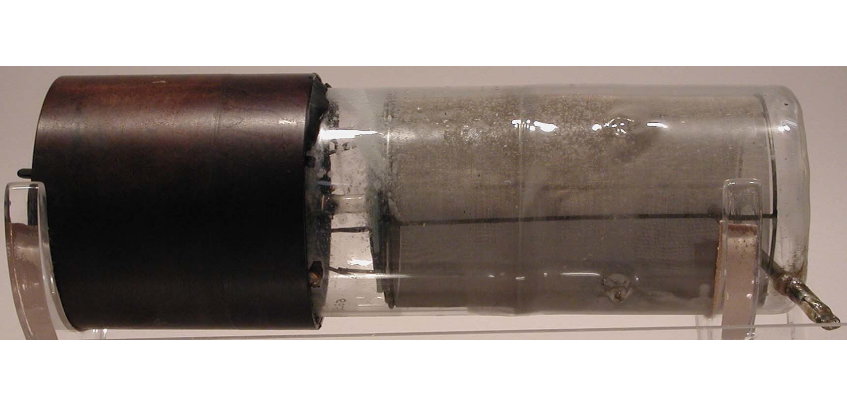
The image dissector focused light onto a photosensitive surface, preserved the scene as an electron distribution and sampled that distribution through a small aperture.

Farnsworth image dissector tube
Philo T. Farnsworth's image-dissector transmission tube.Selected from Ali Chourba's original course document.
01
PHOTOEMISSION

The optical scene becomes an electron image.

Visible light from the scene was focused onto a specially coated photosensitive detector at the front of the evacuated tube. Brighter regions released more electrons than darker regions, so the emitted charge distribution preserved the spatial brightness pattern.

The resulting “electron image” existed inside the tube rather than as a mechanical pattern of holes. An anode established the field needed to collect and direct the emitted electrons.

02
DISSECTION

A small aperture samples one area at a time.

The tube measured only a small part of the electron image at any instant. Deflection fields moved the electron distribution across a fixed aperture so successive image locations contributed to the output current.

Repeated horizontal and vertical scanning converted the whole image into a time-varying electrical signal. The method performed the same space-to-time conversion as Nipkow's disk but without rotating the image scanner.

03
SIGNIFICANCE

The camera becomes fully electronic.

Farnsworth's 1927 design demonstrated the central principle of an electronic television camera: convert photons into electrons, scan electrically and produce a serial video signal. Later camera tubes improved sensitivity by storing charge between scans, but the image dissector was a decisive step away from mechanical television.

THE IDEA TO REMEMBER

The image dissector replaced moving scanner hardware with controlled electron motion inside a vacuum tube.

01

INPUT

Focused optical image
02

CONVERSION

Photosensitive electron image
03

OUTPUT

Aperture-sampled video current

COURSE SOURCE · “ELECTRONICS AND TECHNOLOGY” · ALI CHOURBA