Electronics Engineering · CHAPTER 01 · FOCUSED LESSON

Nipkow’s Scanning Disk

Dividing an image into lines for electromechanical transmission.

1883–1884 · GermanyALI'S NOTES · PAGES 14–15

Nipkow converted a picture into one timed signal.

A spiral of holes in a rotating disk scanned successive lines of an image, allowing a two-dimensional scene to travel through a single electrical channel.

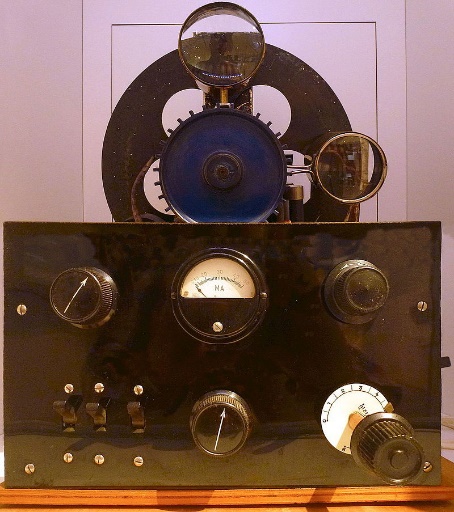
Historical Nipkow disk apparatus
Paul Nipkow's mechanical scanning principle.Selected from Ali Chourba's original course document.
01
SCANNING DISK

Each hole traces one line of the scene.

As a student in 1883, Paul Gottlieb Nipkow conceived a disk perforated with holes arranged in a spiral. The holes were spaced at equal angular intervals and different radii. When the disk rotated, each hole swept across a different horizontal slice of the optical image.

After every hole had passed the image aperture, one full revolution had sampled all lines and therefore one complete frame. The number of holes limited the number of scan lines and the available spatial detail.

02
TRANSMITTER

A selenium sensor converts the scan into pulses.

Light passing through the active hole fell on a light-sensitive selenium cell. As bright and dark parts of the image crossed the hole, the cell's current changed. The disk therefore serialized the image into a time-varying electrical signal that could travel through a telegraph or telephone line.

03
RECEIVER

Synchronization reconstructs the image.

At the receiver, the incoming signal controlled the brightness of a gas-discharge, commonly neon, lamp. A second disk with the same hole pattern rotated at the same speed and phase. Each brightness value appeared at the matching spatial location, rebuilding the picture line by line on a viewing screen.

If the disks lost synchronization, lines shifted or the image rolled. Mechanical television was limited, but raster scanning—the ordered conversion between space and time—survived into electronic and digital imaging.

CONTROLLED MODEL

Rotate one disk and watch the scan line advance.

The active aperture and sampled line are linked; the disk does not simply spin as decoration.

CAUSE → EFFECT
A
BRIGHTNESS SIGNAL ∿∿∿
THE IDEA TO REMEMBER

Scanning lets one channel carry an image by converting space into a synchronized time sequence.

01

ENCODE

Spiral holes scan successive lines
02

TRANSDUCE

Selenium converts light to current
03

DECODE

Synchronized disk and neon lamp

COURSE SOURCE · “ELECTRONICS AND TECHNOLOGY” · ALI CHOURBA