Electronics Engineering · CHAPTER 01 · FOCUSED LESSON

De Forest’s Triode

A control grid turns a small voltage variation into control of a much larger current.

1906–1907 · United StatesALI'S NOTES · PAGES 11–12

The control grid turned a valve into an amplifier.

Lee de Forest placed a fine wire grid between cathode and anode. A small voltage at that grid could control a much larger anode current.

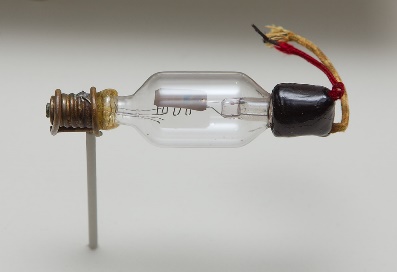
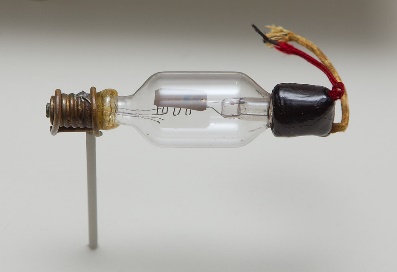
Historical Audion triode
The Audion adds a third electrode—the control grid.Selected from Ali Chourba's original course document.
01
THE THIRD ELECTRODE

A mostly open grid can still control the field.

The Audion keeps the heated cathode and positive anode of Fleming's diode but inserts a mesh of fine wire between them. Most electrons can physically pass through the open spaces, yet the grid's electric potential strongly changes the field near the cathode.

A large negative grid bias repels emitted electrons and cuts off anode current. A less negative grid allows more electrons to cross. The grid therefore controls the stream without needing to carry the full output current.
02
AMPLIFICATION

A small input controls a larger energy flow.

Apply a weak signal to the grid while a separate supply provides anode power. Small changes in grid voltage create larger changes in anode current. A load in the anode circuit converts that current variation into an amplified voltage signal.

The tube does not create signal energy from nothing. The grid signal controls how much energy flows from the anode supply to the output—an operating pattern later reproduced by transistors.

03
THE ELECTRONIC AGE

Amplification made systems practical.

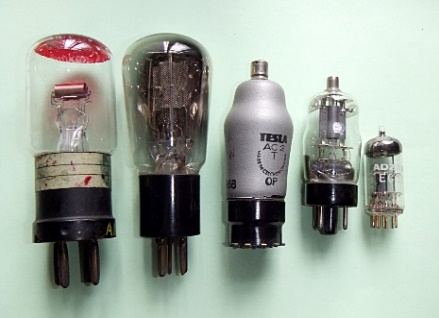
De Forest developed the tube in 1906 and patented the Audion in 1907. Triodes and later tetrodes and pentodes enabled radio broadcasting, long-distance telephony, television and the first electronic digital computers. Those computers were the largest vacuum-tube systems ever assembled.

CONTROLLED MODEL

Adjust grid bias and observe anode current.

More-negative bias suppresses the stream; less-negative bias permits more electrons to reach the anode.

CAUSE → EFFECT
ANODE / PLATE+
CONTROL GRID
HEATED CATHODE
HEATER
ELECTRON FLOWCATHODE → ANODECONVENTIONAL CURRENTANODE → CATHODEGRID BIAS-6.0 VANODE CURRENT90 mA
THE IDEA TO REMEMBER

Amplification is control: a small grid signal modulates a larger current supplied by another energy source.

01

CATHODE

Emits electrons
02

GRID

Controls the electron stream
03

ANODE CIRCUIT

Provides the larger output energy

COURSE SOURCE · “ELECTRONICS AND TECHNOLOGY” · ALI CHOURBA