Electronics Engineering · CHAPTER 00 · FOCUSED LESSON

Charles-Augustin de Coulomb

The torsion balance and the first quantitative law of electric force.

1785 · ParisALI'S NOTES · PAGE 5

Coulomb made electric force measurable.

Charles-Augustin de Coulomb transformed attraction and repulsion from a spectacular demonstration into numerical evidence by measuring how force changes with distance.

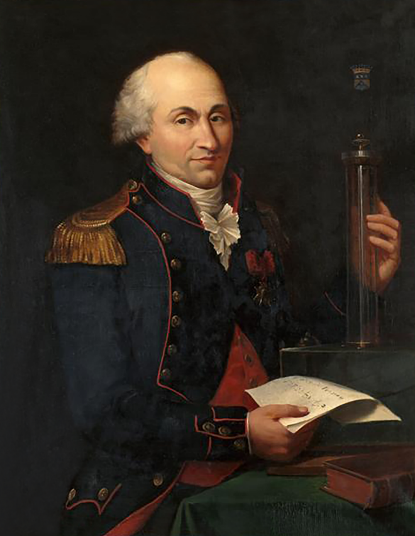
Portrait of Charles-Augustin de Coulomb
Charles-Augustin de Coulomb (1736–1806)Selected from Ali Chourba's original course document.
01
THE INSTRUMENT

A fibre converts a tiny force into an angle.

Coulomb suspended a horizontal needle from an extremely fine fibre made from materials such as silver, copper or silk. A small charged pith ball sat at one end of the needle and a counterweight balanced the other. Because the needle could rotate with very little friction, a weak electrical force could twist the suspension fibre through a measurable angle.

The torsion balance was calibrated: the amount of twist required to hold the needle at a chosen angle revealed the force acting on the charged ball. The instrument therefore translated an invisible interaction into a mechanical measurement.

02
THE REPULSION TEST

Same-sign charges establish the inverse-square law.

Coulomb brought a second, similarly charged pith ball close to the ball on the suspended needle. The repulsion rotated the needle. He changed the separation between the centres of the two balls and measured the restoring twist at each distance.

The result was an inverse-square relationship: the force is proportional to the product of the charges and inversely proportional to the square of the distance. If the separation doubles, the force falls to one quarter; if it triples, the force falls to one ninth.

  • Measure centre-to-centre distance, not the gap between surfaces.
  • Keep the charges and apparatus geometry as stable as possible.
  • Compare force ratios rather than relying on a single reading.
03
THE ATTRACTION TEST

Opposite charges required a second method.

Oppositely charged pith balls tended to jump together and stick when they came too close, ending the measurement. Coulomb therefore used an independent arrangement: a small charged plate on the suspended needle and an opposite charge distributed on a large hollow conducting sphere.

The second method again supported an inverse-square dependence for attraction. Agreement between two different experimental approaches made the conclusion much stronger and launched the quantitative study of electrostatics.

FORMULAE & SI UNITS

Every symbol, defined.

Read the equation together with the physical meaning and SI unit of each parameter.

Coulomb's law — magnitude of the electrostatic force

This equation gives the magnitude. The direction lies along the line joining the two charges: q₁q₂ > 0 means repulsion; q₁q₂ < 0 means attraction.

SymbolPhysical meaningSI unit
FMagnitude of the force acting on each chargenewton (N)
kₑCoulomb constant, approximately 8.99 × 10⁹N·m²/C²
q₁Electric charge of object 1coulomb (C)
q₂Electric charge of object 2coulomb (C)
rCentre-to-centre distance between the chargesmetre (m)
INTERACTIVE CALCULATOR

Set q₁, q₂ and r; calculate the real force.

The model uses the same symbols as the equation. Same-sign charges repel, opposite-sign charges attract, and the force is calculated in newtons.

q₁ · q₂ · r → F
q₁+2 µC2.00e-6 C
F₁₂ATTRACTIONF₂₁
r = 0.50 m
q₂3 µC-3.00e-6 C
COULOMB CONSTANTkₑ = 8.99 × 10⁹ N·m²/C²CALCULATED MAGNITUDEF = 0.216 NBoth charges experience equal-magnitude, opposite-direction forces.
q₁ SIGN
q₂ SIGN
THE IDEA TO REMEMBER

A law becomes convincing when the apparatus measures the relevant variable and an independent experiment confirms the same relationship.

01

SENSOR

Torsion of a fine fibre
02

VARIABLE

Centre-to-centre separation r
03

RESULT

F ∝ 1/r²

COURSE SOURCE · “ELECTRONICS AND TECHNOLOGY” · ALI CHOURBA