Electronics Engineering · CHAPTER 00 · FOCUSED LESSON

Fields, Electrons & Voltage

The essential ideas needed to read the experiments that follow.

Essential languageALI'S NOTES · PAGES 4, 6–7

Electricity, electrons, fields, voltage and electrodes.

These words describe different parts of the same system. Treating them as synonyms creates confusion later, so this lesson separates source, charge, force, motion and interfaces.

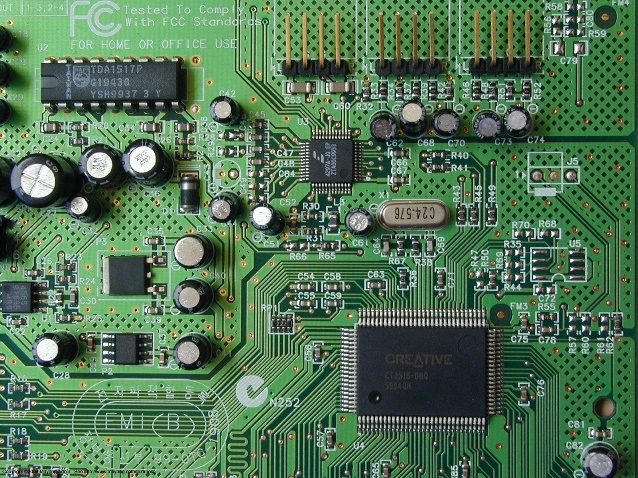
Electronic circuit board
A modern circuit manipulates charge and signals through carefully controlled fields and materials.Selected from Ali Chourba's original course document.
01
ELECTRICITY

A carrier of energy, not a primary fuel.

Electricity is a form of energy transfer associated with electric charge. Power systems generate it by converting primary sources such as natural gas, coal, nuclear energy, wind, sunlight or water flow. The source may be renewable or non-renewable; electricity itself is an energy carrier and is not classified that way.

In circuits, electric current is the rate at which charge crosses a section. In metals the mobile carriers are electrons. A complete explanation must distinguish the motion of those carriers from the much faster establishment of the electric field and the transfer of energy through the circuit.

02
ELECTRONS AND FIELDS

Charge responds to the space around it.

An electron is a negatively charged subatomic particle. In a metal, some electrons can move through the atomic lattice. An electric field exerts force on charge and produces a small average drift of those electrons. Conventional current is defined in the direction positive charge would move, so it is opposite to electron drift in a metal.

A magnetic field describes magnetic influence at every point. Current creates a magnetic field, while changing magnetic fields can create electric fields. These ideas become central in motors, generators, transformers and electromagnetic waves.

03
VOLTAGE AND ELECTRODES

Voltage is energy per charge; an electrode is an interface.

Electric potential difference, or voltage, is the work per unit charge associated with moving between two points in an electric field. Voltage can exist without continuous current when the path is open. Current requires both a driving potential and a conducting closed path.

An electrode is a conductor through which current enters or leaves another medium: a liquid, non-metallic solid, gas, plasma or vacuum. Battery plates, electrolysis contacts and vacuum-tube cathodes and anodes are all electrodes, even though their physical mechanisms differ.

THE IDEA TO REMEMBER

Voltage supplies an energy difference; fields exert force; current measures charge flow; electrodes connect different conducting media.

01

CURRENT

Charge per unit time
02

VOLTAGE

Energy per unit charge
03

ELECTRODE

Conductive interface to another medium

COURSE SOURCE · “ELECTRONICS AND TECHNOLOGY” · ALI CHOURBA