Electronics Engineering · CHAPTER 00 · FOCUSED LESSON

Luigi Galvani

Animal electricity, two dissimilar metals and the frog-leg experiment that started a scientific argument.

1780s · BolognaALI'S NOTES · PAGE 4

The twitch that started a scientific argument.

Luigi Galvani did not merely observe a dead frog move. He built a repeatable electrical path between nerve and muscle, then tried to explain what the contraction revealed about living tissue.

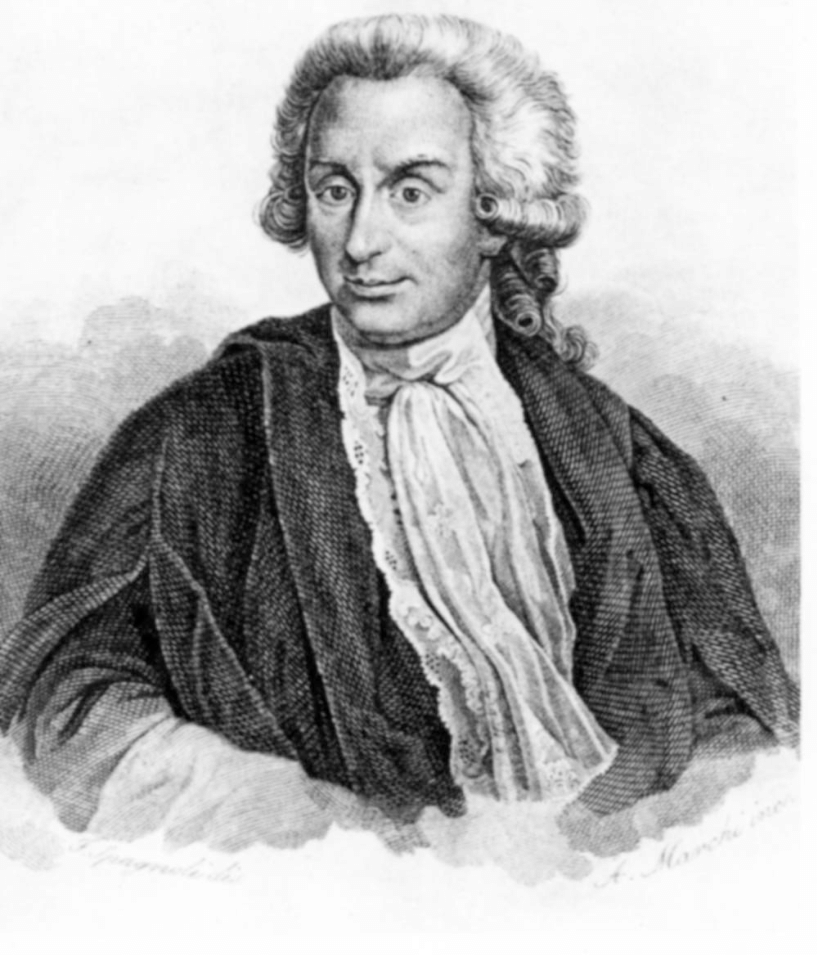
Historical portrait of Luigi Galvani
Luigi Galvani (1737–1798)Selected from Ali Chourba's original course document.
01
THE OBSERVATION

A muscle contracts after the animal has died.

Galvani's studies grew from experiments in which prepared frog legs unexpectedly contracted near electrical apparatus. The striking point was not simply that the limb moved, but that the movement could be produced again under controlled conditions. This suggested that muscle and nerve could respond directly to an electrical stimulus.

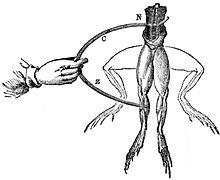
In the disputed experiment described in Ali's notes, the leg remained connected to the spinal cord. Galvani used two different conductors—usually iron with bronze, or iron with silver—to bridge the nerve and the muscle. The metals were not decoration: they completed an electrically conductive path through the preparation.

02
THE PROCEDURE

The decisive moment is circuit closure.

With the two metals separated, the circuit was open and the leg remained still. When their free ends touched, the path closed. Charge moved through the metallic junction and the biological tissue; the muscle received a brief stimulus and contracted. The visible twitch therefore marked an electrical event occurring in the nerve–muscle system.

The experiment must be read carefully: the metal does not pull the leg mechanically, and the entire scene does not shake. The only intended motion is the muscle-driven change in the leg after the conducting path closes.

03
THE INTERPRETATION

Galvani proposed “animal electricity.”

Galvani concluded that electricity was intrinsic to the frog and that the metals acted only as conductors that released it. The proposal influenced science, medicine and popular culture because it linked electrical phenomena to the fundamental question of how bodies produce movement.

Alessandro Volta challenged the explanation. He argued that the contact between dissimilar metals was itself responsible for the electrical effect. Modern physiology recognizes bioelectric potentials in nerves and muscles, while electrochemistry also confirms that dissimilar materials and ionic fluids can create a source. The disagreement was scientifically productive: Volta's attempt to isolate the role of the metals led toward the voltaic pile.

EXPERIMENT WALKTHROUGH

From apparatus to conclusion.

01

Prepare the path

Keep the frog leg connected to the spinal nerve and place two different metals between nerve and muscle.

02

Close the circuit

Bring the metal ends into contact. The electrical path now passes through metal and biological tissue.

03

Observe, then debate

The leg contracts. Galvani attributes the source to the animal; Volta tests whether the metal pair creates it.

THE IDEA TO REMEMBER

The twitch was real; the first explanation was incomplete. Science advanced because the observation could be repeated and the interpretation could be challenged.

01

PREPARATION

Frog leg connected to the spinal cord
02

TRIGGER

Contact between two dissimilar metals
03

VISIBLE RESULT

A localized muscle contraction

COURSE SOURCE · “ELECTRONICS AND TECHNOLOGY” · ALI CHOURBA