Electronics Engineering · CHAPTER 00 · FOCUSED LESSON

Georg Simon Ohm

Experimental evidence becomes a mathematical law linking voltage, current and resistance.

1825–1827 · GermanyALI'S NOTES · PAGE 7

Ohm turned circuit measurements into a predictive law.

Georg Simon Ohm compared voltage, current and the properties of connecting wires, then expressed the relationship mathematically.

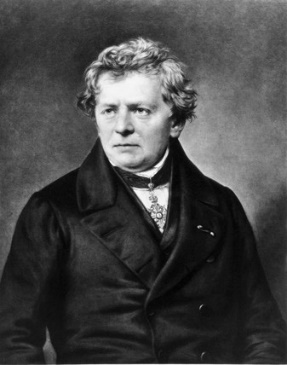
Portrait of Georg Simon Ohm
Georg Simon Ohm (1789–1854)Selected from Ali Chourba's original course document.
01
THE EXPERIMENTAL PROGRAM

Start with evidence, then build the model.

In his 1825 paper, Ohm studied how the electromagnetic effect produced by a wire decreased as the wire became longer. Rather than begin with a finished theory, he tabulated experimental evidence and searched for stable mathematical relationships.

In two important 1826 papers he modelled conduction in electrical circuits using ideas analogous to Joseph Fourier's mathematical treatment of heat conduction. In 1827 he assembled the work into the comprehensive theory associated with his name.
02
THE LAW

Current depends on both the source and the resistance.

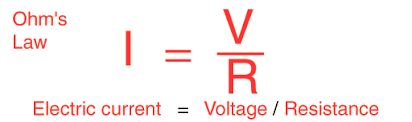
A battery establishes an electromotive force or voltage across a circuit. The connecting wire and other components oppose current. Under stable physical conditions, an ohmic element follows V = I·R. The same relation can be rearranged as I = V/R or R = V/I.

At fixed resistance, doubling voltage doubles current. At fixed voltage, doubling resistance halves current. Resistance is not simply a synonym for a resistor: it is a property that depends on material, length, cross-sectional area and temperature.

03
LIMITS

The law has operating conditions.

Ohm's law often remains valid over a wide range, but it is not universal. Strong heating changes the resistance of a filament; diodes and vacuum tubes have nonlinear current–voltage behaviour. A useful calculation therefore asks whether the component is approximately ohmic and whether temperature and other conditions remain stable.

FORMULAE & SI UNITS

Every symbol, defined.

Read the equation together with the physical meaning and SI unit of each parameter.

Ohm's law

These equivalent forms apply to an ohmic element while its physical conditions, especially temperature, remain stable.

SymbolPhysical meaningSI unit
VPotential difference across the elementvolt (V)
ICurrent through the elementampere (A)
RElectrical resistance of the elementohm (Ω)
CONTROLLED MODEL

Set voltage and resistance; calculate current.

The model applies I = V/R and keeps units visible at every step.

CAUSE → EFFECT
OHM'S LAW24 V50 Ω
=
CURRENT0.480 A
THE IDEA TO REMEMBER

Ohm's law is a conditional model: powerful when the element is ohmic and its physical state is controlled.

01

VOLTAGE

Electrical potential difference, V
02

CURRENT

Rate of charge flow, A
03

RESISTANCE

Opposition to current, Ω

COURSE SOURCE · “ELECTRONICS AND TECHNOLOGY” · ALI CHOURBA