01
CONSTRUCTION
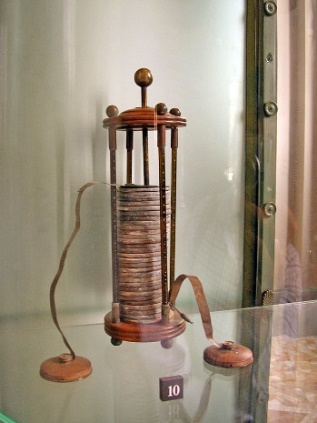
Silver, zinc and brine form a repeatable cell.
Volta stacked discs of two dissimilar metals—described in the document as silver and zinc. Between neighbouring metal pairs he placed cloth or cardboard soaked in salt water. The wet separator acted as an electrolyte: ions could move through it while the two electrode materials participated differently in chemical reactions.
One metal–electrolyte–metal unit produced only a small potential difference. Repeating the unit in the same orientation added the individual voltages, just as cells connected in series still do today.